Aokigahara: The Truth Behind Japan's "Suicide Forest"
The label attached to Aokigahara in English is roughly sixty-five years old and began with a novel. That single fact reorders most of what circulates about this forest online, where the story is usually told as something ancient. This page sets out where the reputation actually came from, which parts of it hold up, which parts were inflated by people with an audience to feed, and what Yamanashi Prefecture asks of anyone who comes here now.
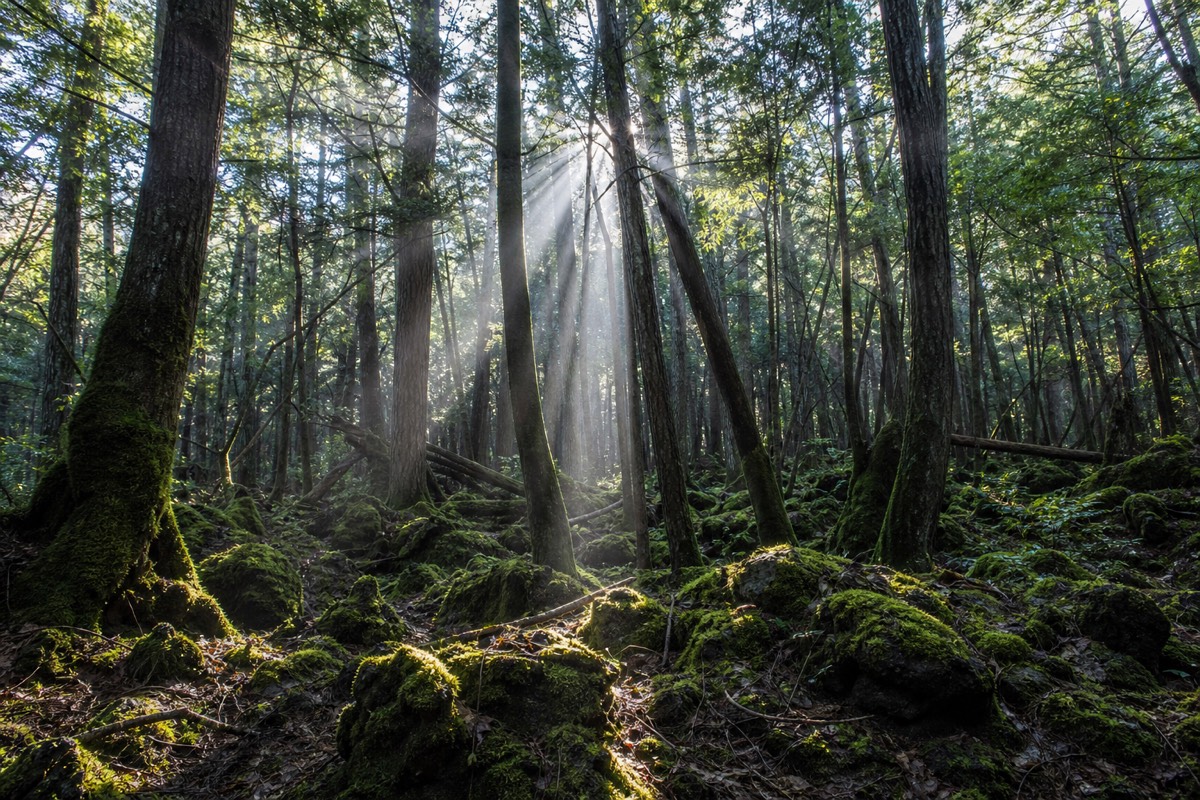
Type Aokigahara into a search bar and the results split into two forests. One is a horror-adjacent legend: ancient, cursed, magnetically hostile, patrolled by ghosts. The other is a national park on the northwestern flank of Mt. Fuji with three ticketed lava caves, signposted hiking paths and a tourism board that would like people to call it Jukai, the Sea of Trees. Both descriptions attach to the same 30 square kilometres of ground. Only one of them survives contact with the sources.
For readers planning an ordinary visit, choose marked trails and natural history. Keep the support resources in this article separate from trip planning.
3.5 hours: Geology commentary followed by a quieter stretch beneath the canopy. English guide; meet at NaturaBase opposite Fuji Lake Hotel and return there. Bottled water included; lunch extra.
Walk The Lava Forest With A Guide · Choose by time and starting pointThis page is the long version of the correction. It exists because the search demand around the darker framing is enormous, and because most of what currently satisfies that demand is wrong, sensational, or both. What follows tries to be accurate about a subject where accuracy matters more than usual.
How Aokigahara's reputation was made
Timeline compiled from Wikipedia (Kuroi Jukai; The Forest), EBSCO Research Starters, contemporaneous reporting on the December 2017 incident and the platform changes that followed, and Yamanashi Prefecture's own English-language tourism guidance. No figures relating to deaths appear here, or anywhere on this page, for the reason explained in the text.
What Does The Phrase Actually Refer To, And Why Does Yamanashi Ask People Not To Use It?
The English phrase refers to the fact that a number of people have died by suicide in this forest over the past several decades. That is real. What Yamanashi Prefecture objects to is the phrase functioning as the forest's name, because a place branded that way in every search result and every travel listicle keeps drawing people to it for that reason.
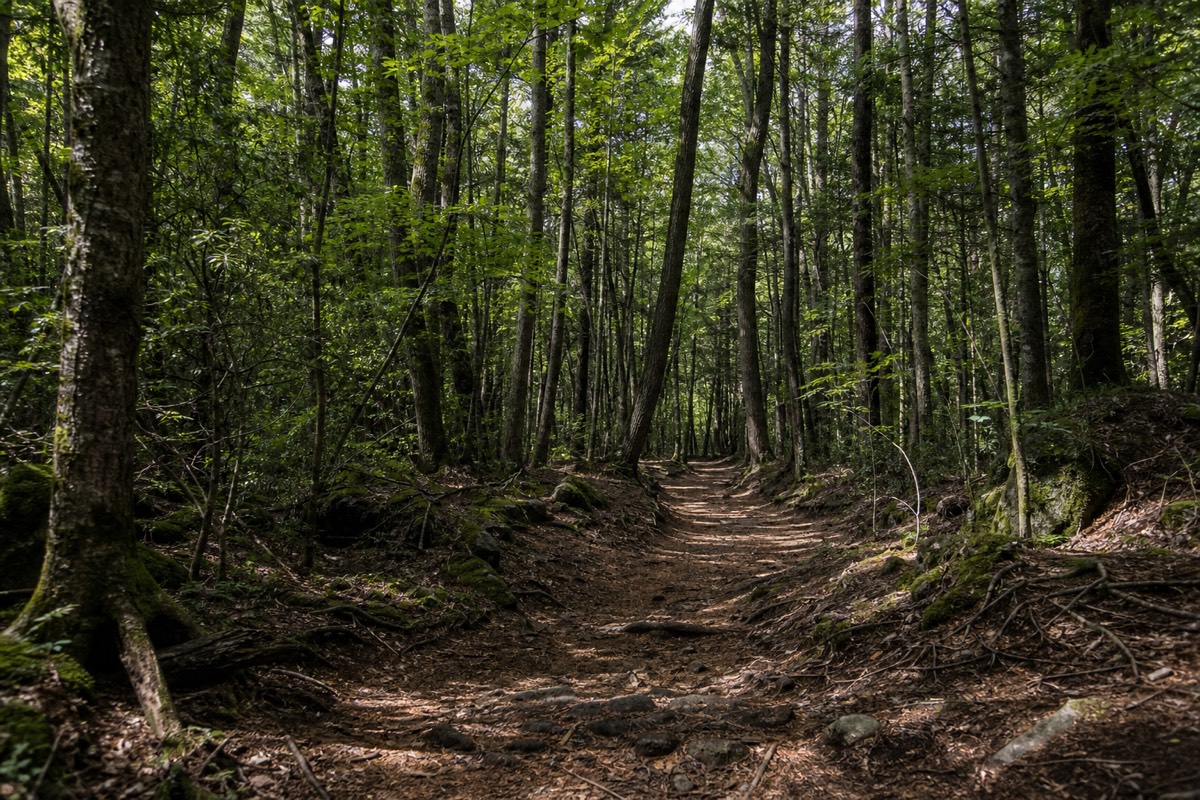
The prefectural government has asked international media to stop using the label. You can see the policy applied on its own English-language tourism page for the forest, which describes designated hiking paths connecting the Narusawa Ice Cave, the Fugaku Wind Cave and the Lake Saiko Bat Cave, notes the quiet and calm atmosphere, corrects a popular myth about compasses, asks visitors not to stray from the official paths, and does not use the phrase at all. That is a deliberate editorial choice by the body with the most direct knowledge of the place.
The reasoning behind it is not squeamishness. It is a well-documented effect in suicide-prevention research, sometimes called the Werther effect, in which prominent, repeated, detailed coverage of a location or a method is followed by more deaths of the same kind. Japanese authorities have organised their entire public posture around that finding. Signs at trail entrances carry messages asking people to think again about their families and offering counselling and debt-counselling contacts. Volunteers and prefectural staff walk the paths looking for anyone in distress. None of that works as well when the wider internet is simultaneously advertising the place.
If you are struggling, or you are reading this because someone you know is:
In Japan, in English: TELL Lifeline, 0800-300-8355, free to call. Their chat service runs daily. Details and current hours at telljp.com/lifeline.
In Japan, multilingual: the Yorisoi Hotline, 0120-279-338, free. Press 2 after the Japanese guidance for English; Korean, Chinese, Tagalog, Thai, Spanish and Portuguese support is also offered.
Outside Japan, your national crisis line will be listed by the International Association for Suicide Prevention. Talking to someone helps more often than people expect it to.
Where Did The Reputation Actually Come From?
It began with a book. Seicho Matsumoto, one of the most widely read Japanese novelists of the twentieth century, published Kuroi Jukai, "Black Sea of Trees", in 1960. It is a crime novel, and it ends with a character walking into Aokigahara to die. The forest's modern association is widely attributed to that book.
Sixty-five years is not nothing, but it is not antiquity either. A reputation that dates to a bestseller published within living memory is a very different object from a curse rooted in the medieval period, which is how the story is usually staged in English-language retellings. Matsumoto did not invent a tradition. He wrote an ending, it landed, and the location in it acquired a meaning that outlived the plot.
Anyone reaching for a deeper explanation should sit with how ordinary that mechanism is. Plenty of real places carry associations that trace to one piece of fiction. The unusual thing here is not the mechanism, it is that the association turned out to be dangerous, and that the danger compounded every time somebody repeated it.
What Happened After The Novel?
The association widened through the 1980s and 1990s, when the forest became the place Japanese media reached for whenever the subject came up. One Japanese book published in 1993 named the location directly. This page will not name that book or describe its contents, for exactly the reason the prefecture later stopped publishing statistics.
That omission is not coyness. Suicide-prevention guidance from the World Health Organization and from national charities is consistent on the point: publicising the material that facilitates harm is itself a form of harm, regardless of the reporter's intentions. A page correcting the record does not need to reproduce the thing it is correcting. Readers who want the bibliographic detail can find it; readers in a bad moment should not have it handed to them by a travel site.
What matters for the historical account is the shape of the curve rather than its contents. A literary association from 1960 became a media pattern by the 1990s. A media pattern became, in the 2000s, an administrative problem serious enough that officials changed how they released information about their own prefecture.
Why Is There No Official Death Count, And Why Is That The Right Decision?
Because Japanese officials stopped publishing the figures in the 2000s, specifically to avoid encouraging more deaths. There is no current official number. That absence is not a cover-up or a data gap. It is a deliberate prevention measure, and it is the honest answer to the question people arrive here asking.
This is the part of the subject that most online content handles worst. Search results are full of confident-sounding annual figures, usually attributed vaguely, usually decades old, frequently contradicting each other. Some of those numbers were real once. Reprinting them now does two things: it presents stale data as current, and it does the exact publicising the prefecture withdrew the data to prevent. So this site does not carry a figure, has never carried one, and will not add one.
If that feels like an evasion, consider what the alternative is for. A visitor deciding whether Aokigahara is worth a morning does not need a body count to make that decision. A journalist writing about Japanese suicide prevention needs national statistics from the Ministry of Health, Labour and Welfare, not a forest-level tally. The only reader genuinely served by a number on a travel page is the reader the prevention measures exist to protect.
What About The Older Folklore, The Yurei And The Ubasute Story?
Two claims usually get stacked here: that Aokigahara is haunted by yurei, the restless spirits of Japanese ghost tradition, and that this is because it was a site of ubasute, the abandonment of elderly relatives in remote places. The first is generic folklore applied to a specific forest. The second is folklore about folklore, and historians doubt the underlying practice was ever widespread at all.
Yurei are entirely real as a cultural category. Japanese ghost tradition is deep, well studied, and populated by spirits bound to the world by grief or anger, and forests have long served in that tradition as liminal ground between the living and the dead. What is much harder to find is primary evidence that Aokigahara specifically carried a distinct, documented haunting tradition before the twentieth century. The sources asserting centuries of specific Aokigahara ghost lore are, in practice, the ghost-content ecosystem citing itself.
Ubasute is the weaker link of the two. The Kodansha Illustrated Encyclopedia of Japan puts it plainly: ubasute "is the subject of legend, but does not seem ever to have been a common custom." The folklorist Kunio Yanagita traced the motif back to Buddhist story tradition arriving from India rather than to Japanese social practice. It survives in Japanese culture as a moral parable, most famously in the Narayama story and its film adaptations, which is a different thing from surviving as history. And even if you set that scholarship aside, there is no evidence connecting the practice to this forest in particular. The chain is a debated custom, attached to an undocumented location, generating spirits that explain a reputation which actually dates to 1960.
What Did The 2016 Horror Film Get Wrong?
Most obviously, the forest. Japanese authorities would not permit filming in Aokigahara, so the production shot its forest sequences in Tara National Park in Serbia, with studio interiors in Belgrade. Only a small amount of the film was shot in Japan at all, including airport scenes at Narita. The Aokigahara audiences watched was a Serbian forest.
The refusal itself is on the record. The film's producer, David S. Goyer, said the Japanese government would not allow the shoot because of concerns about encouraging copycats, and that the production searched worldwide for a forest at a comparable latitude before settling on Serbia. That is a fairly remarkable detail: the single piece of media most responsible for the forest's horror-movie profile among English-speaking audiences contains almost no footage of the forest, because the people responsible for it said no.
Critics were not kind, and not only about the filmmaking. The film sits at 9% on Rotten Tomatoes. Reviewers objected to its use of a real place associated with real deaths as horror set dressing, and to Japanese characters written as scenery or sidekicks in a story set in Japan. It is worth knowing all of this if the film is why you searched for the forest, because the mental image it left is, quite literally, of somewhere else.
What Happened In December 2017, And What Did It Change?
On 31 December 2017 an American YouTuber published a video filmed in Aokigahara containing footage of a person who had died there. The reaction was immediate and close to universal. He removed the video himself, apologised twice, and lost his place in YouTube's Google Preferred advertising tier. The platform then rewrote parts of its rules.
The details of what the video showed are not reproduced here, and the person in it deserved better than to be filmed. What is worth recording is the aftermath, because it was substantial. Within weeks YouTube announced manual human review of everything in the Google Preferred programme rather than relying on automated systems, and raised the threshold for the YouTube Partner Program to 1,000 subscribers and 4,000 watch hours in the previous twelve months. The incident is generally treated as a turning point in how the platform handled monetisation and moderation.
What it did not change is the forest. Two things are true at once here: the episode caused real harm, to the family of the person filmed above all, and it also drove an enormous, lasting wave of search interest that the prefecture has been working against ever since. Some of the people who arrive at Aokigahara today are downstream of a video posted by a stranger nine years ago. That is a strange thing for a national park to have to manage, and it is part of why the local framing has shifted so firmly toward hiking, caves and ecology.
What Is True, And What Has Been Inflated?
The short version: the deaths are real, the reputation's age is not, the supernatural layer is not, and almost every specific figure in circulation is either stale or invented. Here is the accounting, claim by claim.
| Claim | Status |
|---|---|
| People have died by suicide in this forest | True, and documented. It is why the prefecture runs patrols, signage and counselling contacts at trail entrances. |
| The reputation is ancient | Inflated. It traces to a 1960 novel, widening through the 1980s and 1990s. |
| There is a known annual number | No longer. Officials stopped publishing figures in the 2000s as a prevention measure. Numbers you find online are old or unsourced. |
| Compasses fail in the forest | False. Yamanashi's own tourism guidance calls this a common misconception and states that a compass held at normal height behaves as expected. |
| The forest was an ubasute site | Unsupported twice over. Historians doubt ubasute was a widespread practice, and nothing ties it to this forest. |
| The 2016 film shows the real forest | False. Forest scenes were shot in Tara National Park, Serbia, with interiors in Belgrade. |
| The forest is unusually silent | True, with a geological explanation. Porous lava absorbs sound, and a dense, even canopy blocks wind. |
| Visitors are likely to encounter something distressing | Not on the marked paths and cave routes, which are ordinary, well-used tourist infrastructure. |
What Do Yamanashi And Local Guides Actually Ask Of Visitors?
Stay on the designated paths. Treat the place as a working national park rather than a filming location. Do not go looking. Those three requests cover nearly everything the prefecture, the cave operators and the licensed guides in the area consistently say.
The first request is the most repeated and the most practical. Yamanashi's guidance advises visitors against straying from the official paths, and the marked network exists precisely so that a walk through Aokigahara is a walk through Aokigahara rather than an expedition. Designated hiking paths connect the three lava caves; guided walks stay on them as a matter of routine.
The second is about conduct. Filming inside the forest is restricted, and the restriction has a history now. Quiet is the local default, and it is worth honouring even setting the subject aside, because the forest's acoustics reward it.
The third is the one that actually matters and the one that content like this rarely states plainly. A meaningful share of the search traffic around this forest is people hoping to find something. Do not. It is intrusive toward people who have died and toward the families still connected to them, it interferes with the work of the volunteers and rangers who walk these paths for a serious reason, and it takes you off marked trails into terrain where the ordinary risks are real. There is nothing to find that is worth finding.
What Is The Forest The Rest Of The Time?
A young volcanic woodland roughly 1,160 years old, grown on lava from Mt. Fuji's 864 CE Jogan eruption, covering about 30 square kilometres at 900 to 1,300 metres of elevation, with three lava-tube caves inside it and marked paths connecting them. Which is to say: a legitimately interesting piece of geology that happens to carry a reputation it did not earn.
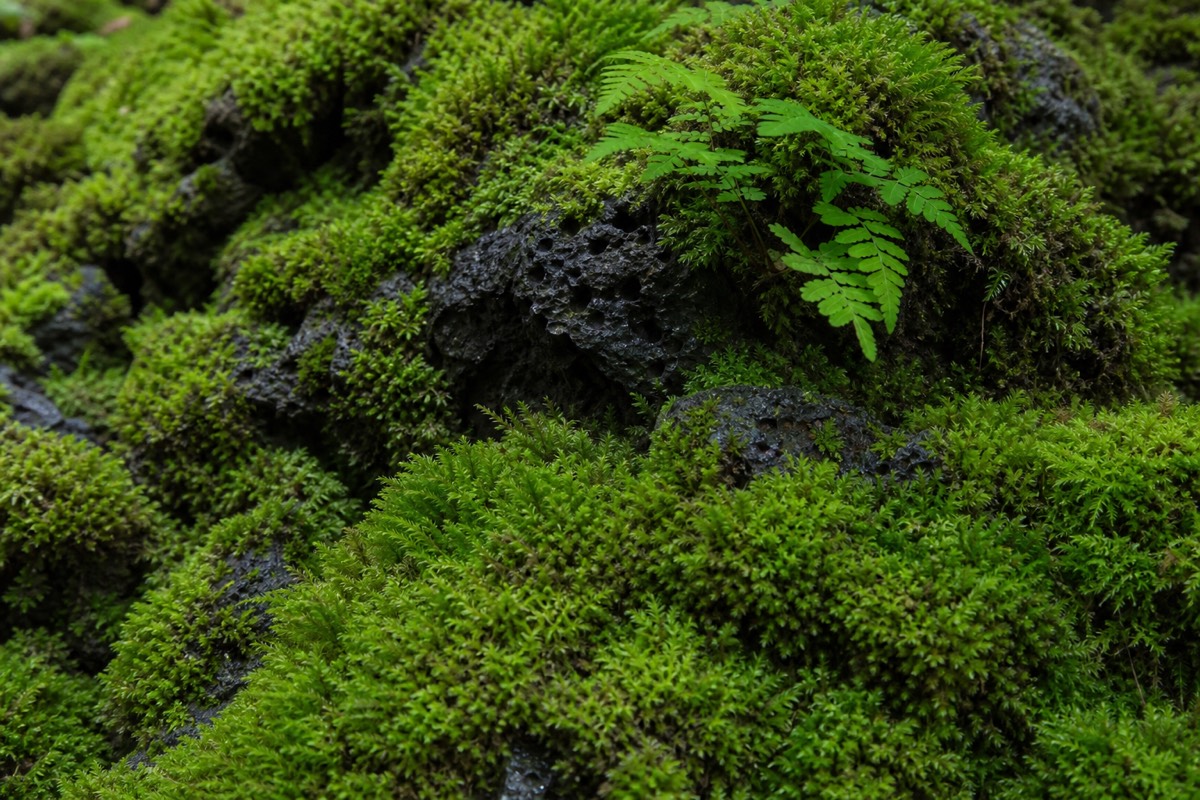
The ground under the trees is hardened lava rather than soil, so roots run sideways across the rock surface instead of down into it. Because no tree can anchor deeply, none grows tall enough to stand above its neighbours for long, which is why the canopy sits at such a uniform height and why the whole forest reads, from an elevated viewpoint, as an unbroken green surface. That is where the name Jukai comes from. It is a description of a real optical effect with a real mechanical cause.
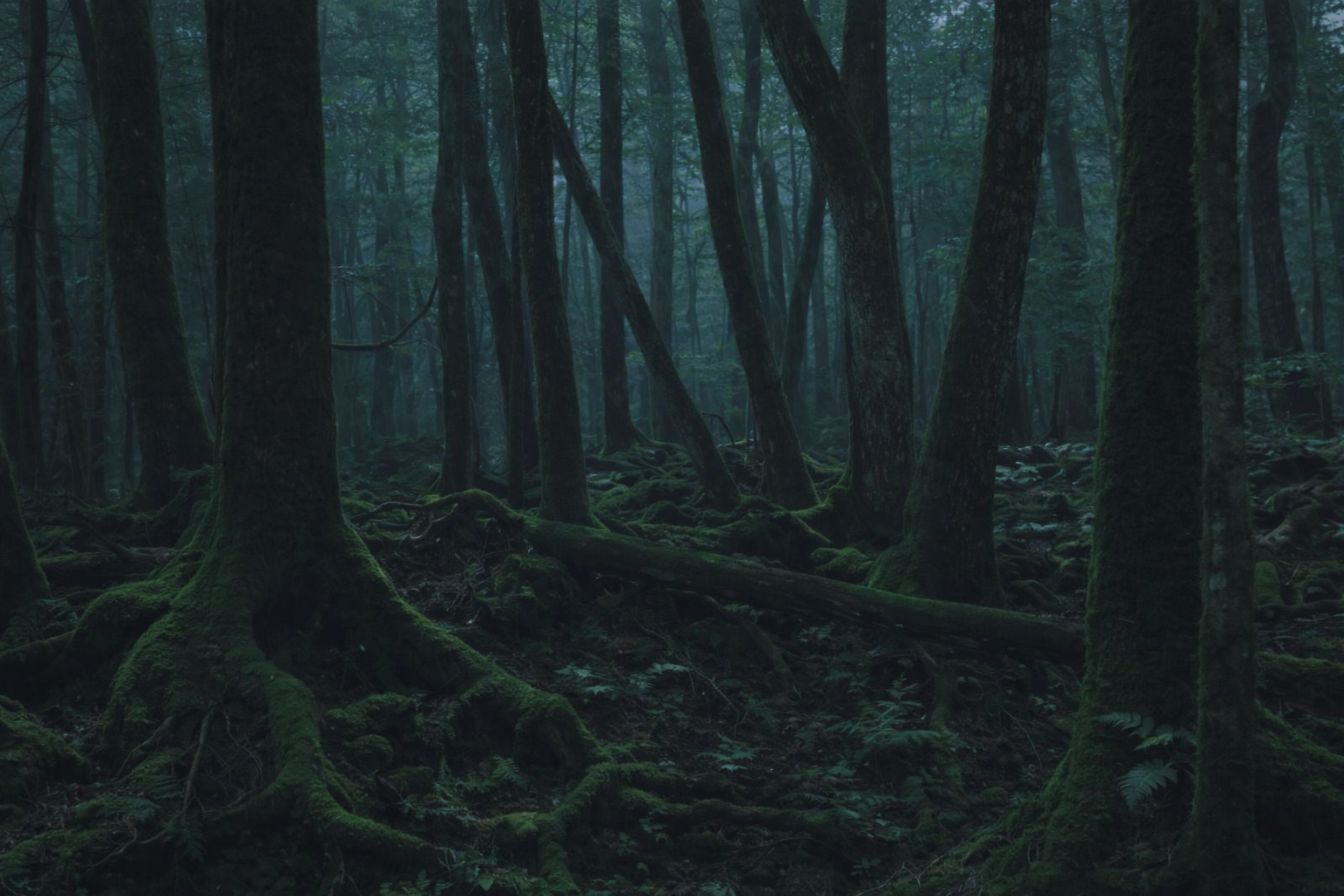
The famous silence has the same kind of explanation. Porous basalt absorbs sound rather than reflecting it, the canopy blocks wind, and the combined effect is a quiet that most first-time visitors name as the thing they remember. Clap inside one of the lava tubes and the sound goes nowhere. There is no need to reach for anything stranger than acoustics.
Underground, the Narusawa Ice Cave holds ice through the summer because of the shape of the tube trapping cold air, the Fugaku Wind Cave stays cool and airy year-round, and the Lake Saiko Bat Cave sits over by its own lake. All three are ticketed, lit, floored and walkable. Above ground there is genuine ecological interest in how a forest colonises bare rock, a bird population adapted to dense conifer cover, and moss doing extraordinary work on a substrate that has no business supporting it.
How To Think About Visiting
If you came to this page from a horror-adjacent search, the useful conclusion is that the interesting version of Aokigahara is the real one. A forest that grew out of a single eruption, that built a level canopy because the rock underneath refuses to hold roots, that swallows sound because of what basalt does to a sound wave, and that spent the last sixty-five years carrying a reputation manufactured by a novelist and amplified by people with audiences to feed. That is a better story than the one in the listicles, and it has the advantage of being accurate.
The practical next step is on the tour pages: how to reach the forest from Tokyo, what the marked trails involve, and what a guided walk or the ice-cave visit adds over going in alone. What belongs here is the last of the three requests above. Come for the trees, the rock and the caves. Stay on the paths. Leave the rest of it alone.